


The Punjab Local Bodies Election 2026 may not decide who forms the next government, but it has certainly revealed the political mood, organizational strength, leadership capacity, and structural weaknesses of every major party heading into the 2027 Punjab Assembly election.
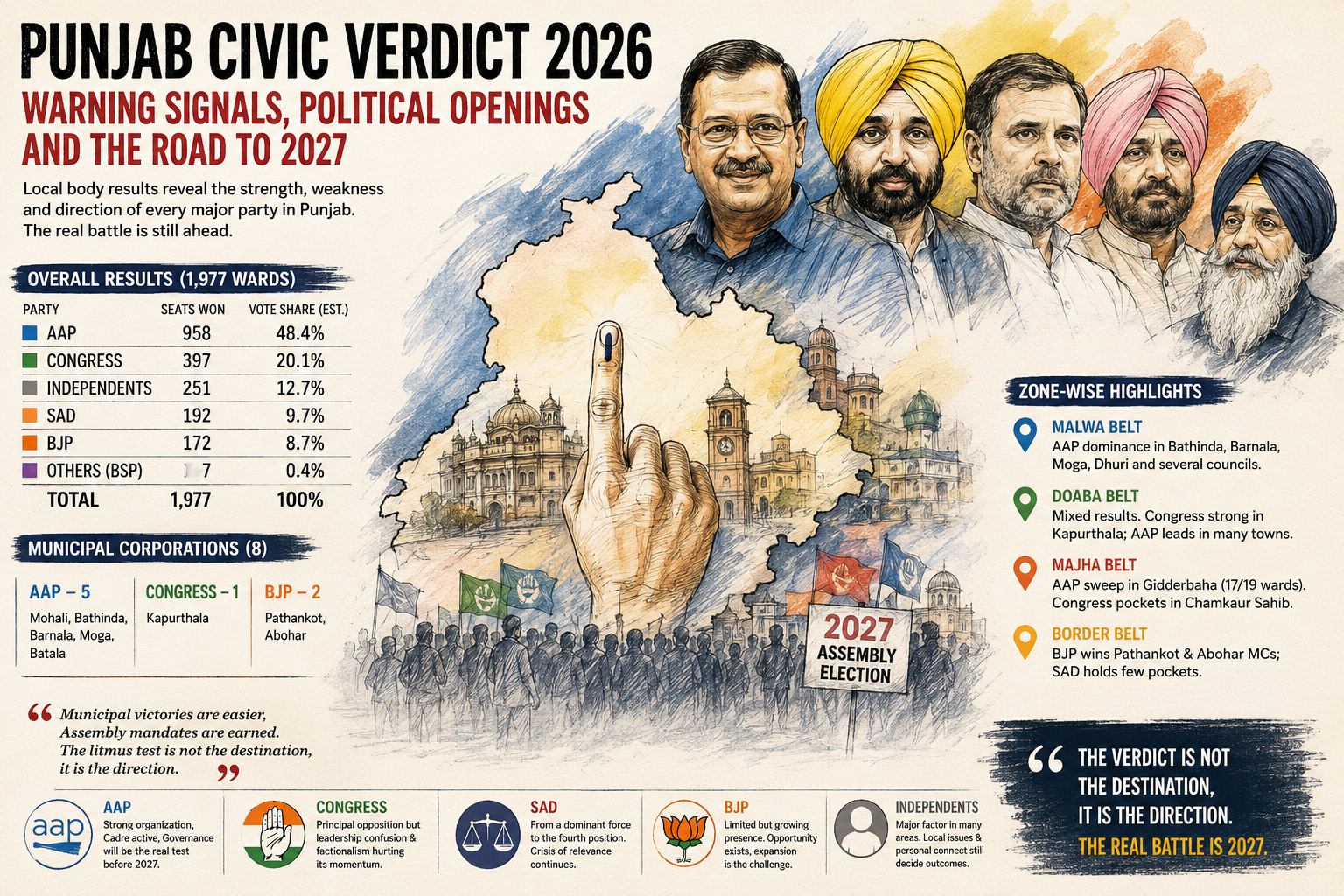
Across 1,977 municipal wards, the ruling Aam Aadmi Party (AAP) secured 958 wards, accounting for nearly 48.4% of the total seats. Congress finished a distant second with 397 wards (20.1%), while Independents emerged as a major political factor with 251 wards (12.7%). The Shiromani Akali Dal (SAD) was pushed to fourth position with 192 wards (9.7%), while the BJP secured 172 wards (8.7%).
Out of eight Municipal Corporations, AAP won five — Mohali, Bathinda, Barnala, Moga and Batala. Congress managed to capture only Kapurthala, while BJP secured Pathankot and Abohar.
The verdict clearly establishes one fact: AAP remains Punjab’s strongest political force. However, the deeper story lies beneath the numbers.
Zone-Wise Political Message
The election was not merely a battle between parties; it was also a contest between political power centres.
AAP dominated large sections of Malwa and urban Punjab, particularly in Dhuri, Mohali, Bathinda, Moga and several municipal councils where its organizational structure remained visibly stronger than the opposition.
Congress displayed strength only in selective pockets.
Former Chief Minister Charanjit Singh Channi’s influence zone of Chamkaur Sahib delivered a strong performance, with Congress winning 11 out of 13 wards. Similarly, Rana Gurjit Singh demonstrated organizational control in Kapurthala, where Congress secured 31 out of 50 seats and captured the Municipal Corporation.
The most politically damaging outcome for Congress emerged from Gidderbaha.
AAP won 17 out of 19 wards in the home turf of Punjab Congress President Amarinder Singh Raja Warring. At a time when Congress is attempting to project a statewide alternative, such results inevitably trigger questions regarding leadership effectiveness and organizational control.
AAP: Recovery After Delhi or Temporary Relief?
Following its setback in Delhi, many observers expected AAP’s political momentum to weaken.
Instead, Punjab has provided the party with a fresh political lifeline.
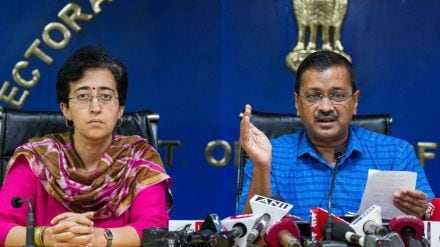
One cannot ignore the aggressive political re-engagement of Arvind Kejriwal and Manish Sisodia after the Delhi defeat. Rather than retreating, both leaders intensified their focus on Punjab. Continuous cadre interaction, governance monitoring, and political outreach helped reinforce the perception that Punjab remains AAP’s most valuable political fortress.
The civic results indicate that the party’s booth-level machinery remains active and disciplined.
However, history offers a strong warning against overconfidence.
In 2015, the SAD-BJP alliance dominated Punjab’s municipal elections by winning nearly 1,420 urban wards. Yet within two years, the alliance was reduced to only 18 Assembly seats while Congress swept to power with 77 seats in 2017. Similarly, in 2021, Congress captured more than 1,500 local body seats, but within months AAP stormed to power with 92 Assembly seats in 2022.
Therefore, municipal success should be viewed as a political advantage, not an electoral guarantee.
AAP has won the first round, but the Assembly election will be judged on governance, employment, law and order, industrial growth, agriculture, and anti-incumbency.
Congress: Opposition Without Direction?
The Punjab Congress remains the only party with a statewide presence capable of challenging AAP.
Yet the local body elections have exposed what may be its biggest weakness: leadership uncertainty.
The post-election developments reveal a troubling picture. Instead of celebrating pockets of success, Congress leaders reportedly engaged in blame games and factional confrontations. The contrasting performances of Channi, Rana Gurjit Singh and Raja Warring have further intensified internal competition.
The question before Congress is simple:
Who is the face of the party in Punjab?
Is it Raja Warring, who holds the organizational command?
Is it Channi, who still retains substantial grassroots appeal among several social segments?
Or is it regional leaders like Rana Gurjit Singh, who continue to demonstrate local organizational effectiveness?
Unless Congress resolves its leadership dilemma, it may remain a visible opposition but struggle to become a winning alternative.
The civic verdict has not strengthened Congress; it has exposed Congress.
Akali Dal: A Crisis Beyond Elections
For Shiromani Akali Dal, the results are perhaps the most alarming.
A party that once dominated Punjab politics now finds itself behind AAP, Congress and even Independents.
The fourth-place finish is not merely an electoral setback; it is evidence of organizational erosion.
Although isolated performances such as Majitha and Rampura Phul indicate that the Akali core vote still exists, the party has failed to demonstrate statewide recovery.
The local body elections suggest that SAD is still searching for a revival strategy rather than executing one.
Unless the party rebuilds its cadre network, reconnects with younger voters and establishes a new political narrative, the road back to power will remain extremely difficult.
BJP: Small Numbers, Bigger Possibilities
At first glance, BJP’s 172 wards may appear modest.
Yet politically, the party may have emerged with more opportunities than the numbers suggest.
The BJP expanded significantly from its previous municipal footprint and secured control of Pathankot and Abohar. More importantly, the continuing decline of the Akali Dal is gradually creating political space that did not exist earlier.
The challenge for BJP is that Punjab politics still lacks a strong statewide BJP-centric leadership structure.
The party’s growth remains concentrated in urban and Hindu-dominated pockets.
If BJP succeeds in converting urban expansion into a broader Punjabi political narrative, it could emerge as a stronger factor by 2027.
For now, however, it remains an expanding player rather than a principal challenger.
Why Local Body Elections Are Called a Litmus Test
Municipal elections are often described as a “litmus paper test” because they reveal the health of a party’s grassroots machinery.
They indicate:
- Booth management capacity
- Worker motivation
- Local leadership strength
- Voter connectivity
- Organizational discipline
However, they do not necessarily predict Assembly outcomes.
Punjab’s own history proves this repeatedly.
The party winning local bodies has lost subsequent Assembly elections more than once. Therefore, civic elections should be treated as an organizational report card rather than a final electoral forecast.
The Real Verdict
The Punjab Local Bodies Election 2026 has delivered different messages to different parties.
AAP has received confidence but not certainty.
Congress has received warning signals rather than momentum.
The Akali Dal has received an alarm bell.
The BJP has received an opening.
The biggest conclusion emerging from this election is that Punjab’s political battle for 2027 remains completely open.
The ruling party has demonstrated organizational strength.
The opposition has demonstrated organizational confusion.
And in politics, when one side is disciplined while the other side remains divided, the advantage naturally belongs to the ruling establishment.
Yet history also reminds us that Punjab voters have repeatedly surprised political analysts.
The civic verdict has revealed the current balance of power.
The Assembly election will decide whether that balance survives.
Sunil Mishra
Political Analyst & Author of Roadmap to Win Election in Last Hour
This Post Has One Comment
A great and very deep analysis about punjab local and state election.