
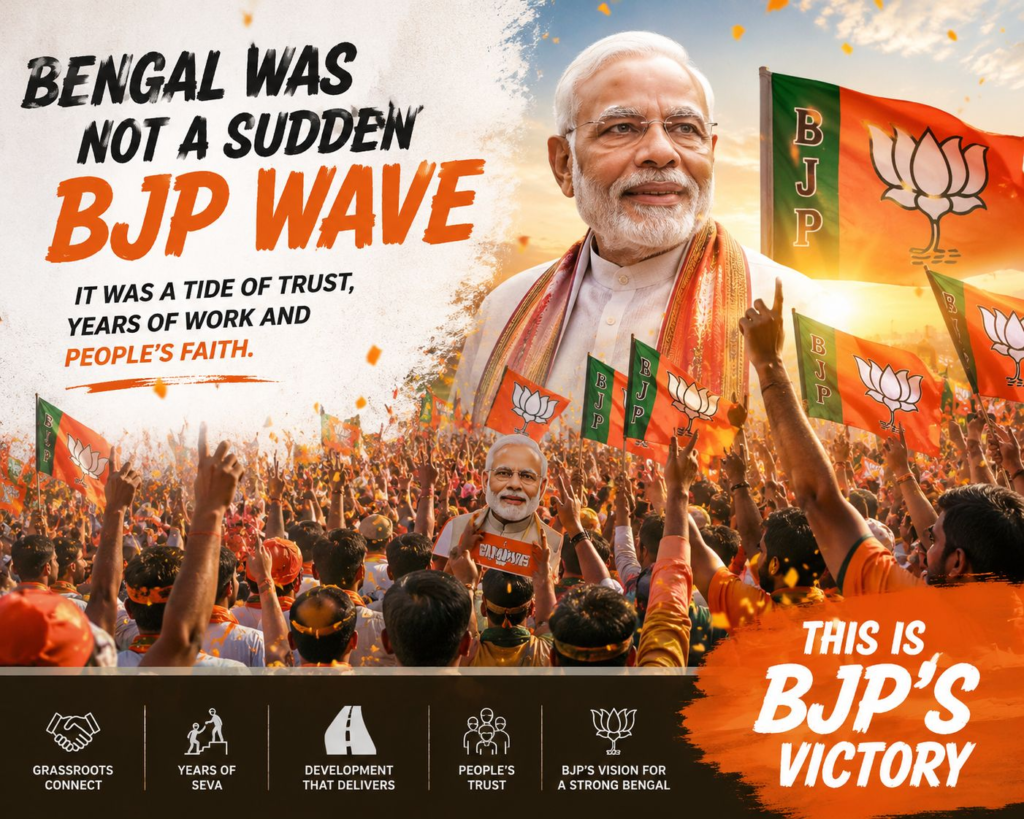
How BJP Systematically Broke the “No One Can Defeat Mamata Banerjee” Narrative in West Bengal
For more than a decade, politics in West Bengal revolved around one dominant perception —
“No political party can challenge Mamata Banerjee.”
After ending the 34-year Left rule in 2011, Mamata Banerjee became more than a Chief Minister. She emerged as the emotional face of Bengal politics. Her aggressive leadership style, mass connect, welfare politics, and street-fighter image created an aura of invincibility around the All India Trinamool Congress.
But elections are never won only through emotions.
They are won through political arithmetic, booth management, voter psychology, cadre discipline, narrative creation, and long-term organizational investment.
The rise of Bharatiya Janata Party in Bengal was not accidental. It was one of the most strategically planned political expansions in modern Indian politics.
This was not a wave.
This was groundwork.
BJP’s Bengal Expansion Was Built Step by Step
The BJP that contested Bengal in 2011 was politically insignificant. The party lacked strong Bengali leadership, grassroots structure, and booth-level influence.
But instead of chasing instant victory, BJP focused on long-term penetration.
The strategy was simple:
- Replace the Left and Congress psychologically as the main opposition.
- Build booth-level cadre aggressively.
- Consolidate anti-TMC sentiment under one political umbrella.
- Convert cultural identity into electoral consolidation.
The electoral numbers themselves explain the transformation:
| Election | BJP Vote Share |
|---|---|
| 2011 Assembly | ~4% |
| 2014 Lok Sabha | ~17% |
| 2016 Assembly | ~10% |
| 2019 Lok Sabha | ~40% |
| 2021 Assembly | ~38% |
This was not natural growth.
It was engineered political expansion.
The BJP first entered Bengal politically through narrative, then through organization, and finally through voter psychology.
The Biggest Political Shift: Hindu Vote Consolidation
One of the strongest factors behind BJP’s rise was the consolidation of Hindu voters cutting across caste and regional lines.
For years, Bengal politics remained fragmented among Left ideology, regional identity, minority consolidation, and welfare-based politics. BJP changed the framework completely.
The party successfully built a perception among large sections of voters that:
- minority appeasement politics was increasing,
- Hindu cultural identity was being politically ignored,
- local TMC cadre had become aggressive and unchecked,
- and political favoritism was affecting governance balance.
Whether entirely accurate or politically amplified is secondary. In elections, perception often becomes larger than policy itself.
BJP converted emotional dissatisfaction into political consolidation.
This became the foundation of its Bengal growth.
TMC’s Biggest Weakness: Lack of a Strong Development Model
Despite welfare success and political dominance, TMC struggled to build a transformational economic narrative for Bengal.
Unlike states projecting strong industrial or infrastructure growth models, Bengal’s governance narrative remained heavily personality-centric around Mamata Banerjee herself.
Gradually, a section of youth and urban voters began asking:
- Where is Bengal’s industrial revival?
- Why are educated youth migrating outside the state?
- Why is Bengal not attracting major private investment at scale?
- Why is the employment ecosystem weaker compared to other emerging states?
This created a silent aspirational vacuum.
BJP intelligently used this gap by presenting Bengal as a state with huge cultural and intellectual strength but lacking economic momentum.
The political messaging was subtle but effective:
“Bengal has talent, but it needs direction and growth.”
That argument connected strongly with first-time voters and middle-class urban families.
Mamata Banerjee’s Aggressive Leadership Became a Double-Edged Sword
Mamata Banerjee’s combative politics initially helped her rise. People admired her anti-establishment image and emotional energy.
But over time, aggressive politics without organizational moderation created fatigue among sections of voters.
The BJP strategically amplified:
- constant confrontation with the Centre,
- political clashes,
- aggressive statements from local TMC leaders,
- cadre culture,
- and perceptions of intolerance toward opposition voices.
Every controversy became part of BJP’s larger narrative:
“Democracy and political balance are under pressure in Bengal.”
This communication strategy worked effectively, especially among politically neutral urban voters.
BJP’s Real Success Was Booth-Level Engineering
The BJP’s Bengal rise cannot be understood only through speeches or national leadership popularity.
Its biggest achievement was organizational expansion at the booth level.
For nearly 15 years, BJP invested continuously in:
- booth committees,
- RSS-linked ideological groundwork,
- cultural outreach,
- women mobilization,
- local influencer networks,
- temple and festival engagement,
- migrant voter connection,
- and digital communication systems.
Even after defeats, BJP kept expanding.
This is what separated BJP from traditional opposition parties in Bengal.
While others reacted election-to-election, BJP worked constituency-to-constituency.
By 2021, BJP had transformed itself from an outsider party into Bengal’s primary opposition ecosystem.
Collapse of the Left Helped BJP More Than TMC Expected
The decline of the Left Front created one of the biggest political vacuums in Bengal’s history.
Traditional anti-TMC voters needed an alternative capable of challenging the ruling party seriously.
Congress lacked organizational energy.
The Left lost emotional momentum.
BJP captured that political space aggressively.
Many voters who historically never supported BJP shifted strategically because they saw it as the only viable challenger against TMC.
This was not merely ideological voting.
It was strategic anti-incumbency consolidation.
Bengal Was Not a “Wave Election”
The biggest misconception among political observers is that BJP’s Bengal growth happened because of a temporary wave.
The reality is very different.
The Bengal model was built through:
- long-term cadre investment,
- emotional narrative creation,
- identity consolidation,
- booth management,
- aggressive communication,
- and sustained political patience.
The BJP did not suddenly become strong in Bengal.
It spent nearly 15 years preparing Bengal psychologically before challenging it electorally.
That is the real story behind Bengal politics.
Final Political Analysis
The BJP’s biggest victory in Bengal was not seats.
It was breaking the psychological myth that Mamata Banerjee was electorally untouchable.
Once voters started believing BJP could replace TMC, Bengal’s political arithmetic changed permanently.
At the same time, TMC’s inability to create a strong economic-development narrative, combined with aggressive cadre politics and identity-based perception battles, gave BJP the political opening it had been waiting for.
Bengal today is no longer a one-party emotional fortress.
It has become a highly competitive ideological battleground.
And that transformation did not happen through one election.
It happened through 15 years of strategic political engineering.
About the Author
Dr. Sunil Mishra is a Poll Consultant, political strategist, and CEO of Roadmap to Winn Research. He is also the author of the widely discussed election strategy book Roadmap to Win Election in Last Hour. Dr. Mishra has been credited with consulting multiple Indian political parties at both central and regional levels and has worked with several Chief Ministers and senior political leaders on campaign strategy, voter behavior, booth management, and electoral research across India.